
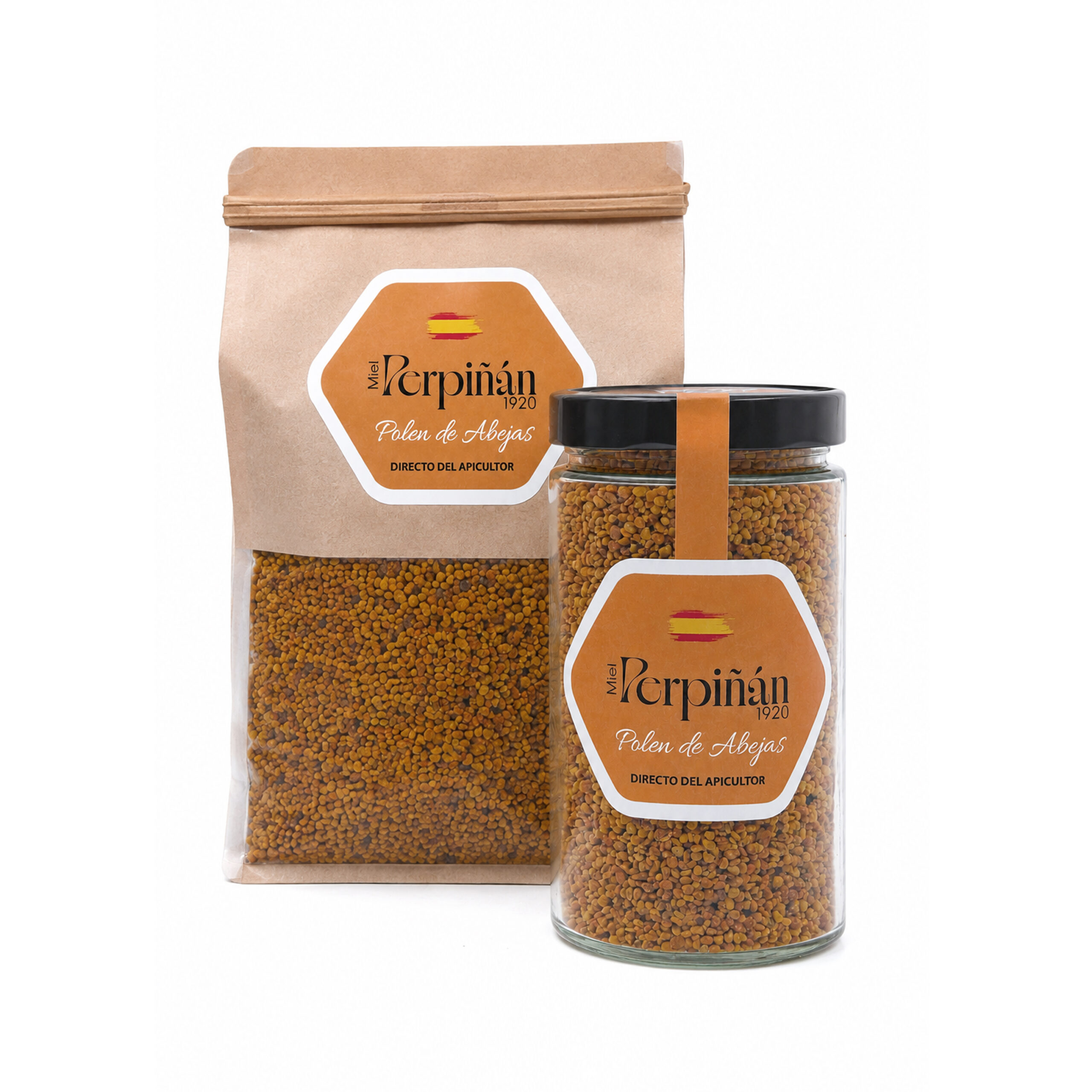
Pollen is considered a superfood that stands out for containing almost all the nutrients that humans need. It is the only food that contains all 22 essential amino acids.
It is collected by the bees, when they land on the flowers and in small cavities on the back of their legs, they transport it and moisten it with the nectar of the flower to create small balls, which will be the food of the worker bees.
Pollen is collected by the beekeeper when the bee is about to enter the hive.
It is an exceptional food, rich in protein. It is also a great source of vitamins and minerals. Its nutritional richness makes flower pollen an extraordinary food supplement, which compensates for possible deficiencies in our usual diet.
Properties
Rich in proteins and amino acids, it is worth highlighting proline that participates in the production of collagen in the body, glotamic acid that helps fight free radicals and tryptophan, which is an essential amino acid that the body does not produce and must be obtained from food.
Mineral Salts, iron that contributes to the formation of red blood cells and hemoglobin, to the proper transport of oxygen and helps to reduce tiredness and fatigue.
Zinc contributes to fertility, reproduction, the maintenance of bones, hair, nails, skin and vision, as well as normal testosterone levels.
Advisable in cases of impotence and sexual abstinence.
Copper contributes to the normal functioning of the nervous and immune systems and energy metabolism.
Due to its content of flavonoids and phytosterols, pollen can be used as an antioxidant, anti-inflammatory, antimicrobial agent and as a blood cholesterol-lowering agent.
High in fiber, it regulates digestive mechanics, preventing constipation and acting as a protective factor in cases of diabetes and cardiovascular diseases.
Contains Vitamins, Provitamin A, B1, B2, B3, B5, B6, C, H, B9, E
Benefits
• Energy. One of the most important benefits of pollen comes from its energizing and revitalizing properties. Increases work capacity and lowers blood pressure. The effects of pollen consumption begin to be noticed after a few days, increasing resistance to fatigue.
• Stimulates appetite. Taken before meals, pollen can have excellent appetizer properties, resulting in a good appetite stimulant.
• Indicated for intestinal and liver problems. Bee pollen is also taken for problems with the liver and digestive system in general.
• It is good for anemia. Since it promotes the production of red blood cells, it also helps healing, which is why it is indicated in cases of ulcers.
• Ideal for stimulating the mind. Bee pollen contains aspartic acid which is indicated for states of fatigue, depression, anxiety, irritability and nervousness, among other disorders. It is also common to take it to improve intellectual capacity, being beneficial for studying.
• It is used for the elderly, children and pregnant women. In addition, it is ideal for recovering vitality, which is why its consumption is recommended for weak, convalescent, stressed, elderly and pregnant women. In children, pollen promotes growth.
• Good for the prostate. Pollen consumption could help combat inflammation that occurs in the prostate.
• Beauty. Beauty begins with the glow of good health. Studies have shown that unhealthy or aging skin can be dramatically improved by consuming bee pollen. When bee pollen is included daily in your diet, it not only gives you the glow of health, it can be used to soften, calm and rejuvenate the outside of your body and can even eliminate acne. Through transcutaneous nutrition, bee pollen exerts a profound biological effect. It appears to prevent premature aging of cells and stimulates the growth of new skin tissue. It offers effective protection against dehydration and injects new life into dry cells. Smoothes wrinkles and stimulates a blood supply that gives life to all skin cells.
Use
If you are wondering how to take bee pollen it acts faster when taken with meals, especially with fruit, which gently helps the intestinal flora. In adults, take 1 tablespoon at breakfast, preferably with a piece of fruit since the fibers in the fruit reinforce pollen activity. It can also be taken with yogurt, juice, milk or alone. Children, ½ tablespoon.
Conservation
Store in a cool, dry place, away from light
Contraindications
It is contraindicated in allergic people. (Consult the doctor)
Production area
Spain.
Format: ECO package 250 g | ECO package 350 g | Glass jar 500 g | ECO package 750 g | ECO package 1 kg
Nutritional Information: (Average value per 100g.) Energy value: 1508 Kj /359 Kcal
Fat: 6.9 g. (of which saturated 2.2 g.) Carbohydrates: 48.4 g. (of which sugars 40.7 g.) Proteins: 17.50 g. Dietary fiber: 16.6 g